


Research Question: Why is it important to save our pollinators and what can we do to help?
Brookwood first graders are learning to become citizen scientists through the close observation of pollinators and why they are important to our ecosystem. We begin our study of pollinators in the fall when we study the migration and life cycle of monarch butterflies. We learn about the life cycle and migration patterns of Monarch butterflies, focusing on what is needed to support their diminishing population. Students bring some caterpillars into the classroom, rear them into adulthood, and tag them before releasing. Students learn about the basic needs of animals by creating classroom habitats in which Monarchs can progress through the stages of their life cycle free of predators and parasites.
In order to support the local pollinator population our students started pollinator gardens. Students research the kinds of plants needed in a pollinator garden and which flowers attract Monarch Butterflies and bees. We reached out to Home Depot and Lowes and received seed donations. All the flowers are grown in our greenhouse, and we invited Mrs. Ensley to teach us how to transplant our flowers. Students observe the pollinator gardens and tally the different pollinators seen in the gardens. Through a grant our school was able to get a bee observatory. Students love getting to watch the busy bees at work. While the bees are working, students love to try and find the queen. In our stem journals, students write what they observe in the bee observatory. A real life beekeeper came to speak to our students about how to take care of a beehive. Students also had the chance to try some delicous honey right from the honeycomb.
During the winter months, students winterize classroom gardens, protecting them from weeds and ensuring they will be ready for spring planting, as well as observe the changes in the bee colony. Through this process, students learn how the seasons affect pollinators and gardens. Students also begin thinking about and discussing how they can make civic contributions once spring arrives.
In the spring, students begin pulling weeds and readying the pollinator gardens for a new planting season. Each garden is studied and students determine what needs to be planted to maintain the success of their gardens as attractors of pollinators. In March Monarchs return from their winter resting place in Mexico and the students are excited to see the next generation enjoying the flowers that were planted in the gardens.
Use of Data: Students record data related to their STEM project in a variety of ways.
- Students tally the number of eggs and caterpillars are found in the gardens
- They keep track of each instar in our classroom habitat.
- Students record the number of adult monarchs that are tagged and released. The tag numbers are sent to MonarchWatch.org. When the monarch is found, the tag number is reported back to us and we are told the location where the monarch has traveled.
- Students create graphs and charts showing how many females and males emerge from the chrysalis
- Students take a census of the number of pollinators observed in the gardens. This is in partnership with both the Great Georgia Pollinator Project and the the Great Sunflower Project.


Our Partners: In order to further our research work we rely on our expert partners to help us.
- Our project was started with the help of the Tennessee Aquarium, supplying milkweed for gardens and guidance in tagging and releasing.
- We have partnered with Journey North to report local sightings of adult monarchs.
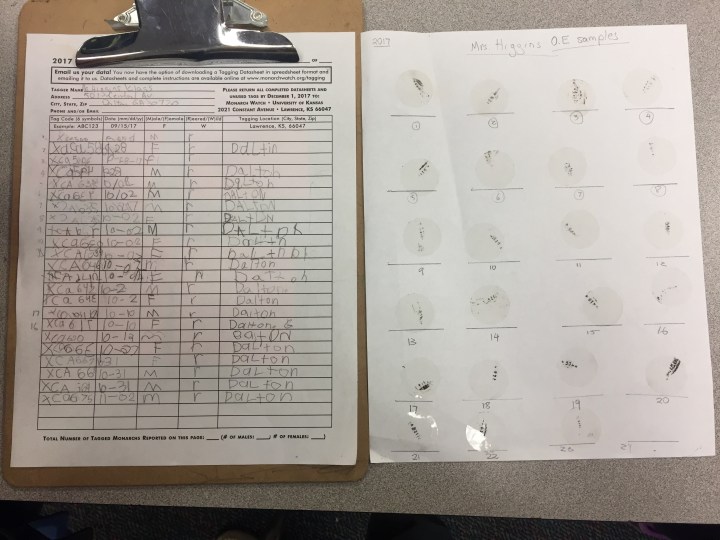
- In partnership with the University of Georgia, we have collected samples from each adult monarch, testing for the O.E. parasite.
- We work with MonarchWatch.org to tag and release adult monarchs.
- We have partnered with schools and the community to plant butterfly gardens around the city of Dalton. Gardens can be found at such places as the Dalton-Whitfield Public Library, several assisted living communities, and most elementary schools in our district.
- We partner with Shepard’s Mulch each year to provide mulch for our classroom and community gardens.
- Lowes and Home Depot donate seeds for us to plant each year.
- Timofey Kurochka of Cleveland, Tennessee donated our first bee colony, a hive of Italian Honeybees.
- Barnyard Bees in Chatsworth provides information and assistance as we cotinue to learn about how to keep bees.
Civic Contributions to our Community:
Each year the civic contribution project focuses on sharing information about pollinators with the community. These civic projects are student led and change each year. One year students wrote letters to locals in the community and created informational brochures, offering help in planting a butterfly garden. As a result of this work, several community gardens were established to attract and support local pollinator populations. Another year, students distributed seeds and information on planting a pollinator program to houses in the neighborhood. Students have given presentations about how to care for a pollinator garden and what to look for in monarch migration. Students have planted milkweed and other nectar flowers from seed to donate to these businesses. Each year students create signs or pamphlets to discourage the use of pesticides, as these harm pollinators.
Integration of Core Curriculum with Research:
Students transfer what they learn in the garden and through their observation of Monarchs and bees to the classroom setting through integration of all academic areas.
Literacy
- We read a variety of fiction and nonfiction texts throughout the year related to the butterflies and pollinators. We select books that assist in the ongoing learning and scaffolding of our research.
- We write about shared experiences in our gardens in order to integrate letter knowledge, phonological awareness, high-frequency word knowledge, and the writing process. This is facilitated through interactive and shared writing.
- Students write personal narratives and informational writing about their experiences in the gardens and with their interactions with Monarchs and bees.
Math
- Students gather data on the different types of pollinators seen in our gardens.
- Students record data about the numbers of eggs and caterpillars found both in the gardens and in the classroom.
- Students create different types of graphs and charts to record how many females and males emerge from the chrysalis. We analyze and compare this data between classes.
- Students measure the caterpillars as they grow, observing them as they transform from one instar to the next. This helps us know when they are ready to form their chrysalis.
- Authentic scenarios allow students to solve and create real-world addition and subtraction story problems based on their STEM project.
Social Studies
- Students learn about cardinal directions as they study the Monarch migration patterns.
- Students study maps to follow the migratory path of the Monarchs.
Science
- Students learn about the basic needs of plants and pollinators
- Students learn about the life cycles of bees and Monarch butterflies
- Students consider the hypothesis that Monarch migratory patterns follow the magnetic field of the earth
Our Little Stories Of Effect On Students’ Lives:
“After learning about milkweed and the monarch life cycle, Nati planted a butterfly garden at her home. After letting it grow for a year, she discovered her garden was full of caterpillars. She wanted to share this with as many people as possible, so she persuaded her mom to make a video of her explaining the importance of milkweed. This video was shared with her classmates, teachers, and through social media.”
“After planting a community garden at the local library, Miller and his family wanted to make sure his garden was thriving. Throughout the summer months, they went to the garden on a regular basis, weeding, watering, and observing the population living in the garden. Once fall arrived, Miller was excited to see the caterpillars in this community garden. He even took some caterpillars home to observe the life cycle all over again!”
“Kelly came into my classroom as a shy young girl. She was ESOL and had a learning disability. Throughout the year, her excitement about the monarchs opened her eyes and her personality. Her vocabulary grew in ways I had never seen before. She could talk so excitedly about something she was passionate about. This shy girl had opened up her wings and taken flight, just like a monarch.”
“Corbin and his family created their own butterfly garden at their house. He was able to teach his classmates about organic gardening methods, such as using dried banana peel to deter plant pests.”
Each fall the families at Brookwood Elementary School join together to raise Monarch butterflies both at school and at their homes.
 brookwoodstem.com